Getting started
Running a monthly review
More sources and clients
How the numbers work
What "reconciled" actually means
The checks on every month, and what they do and do not prove.
Every review carries a set of checks. They are folded into one line, for example All 7 checks pass, and open to show each one.
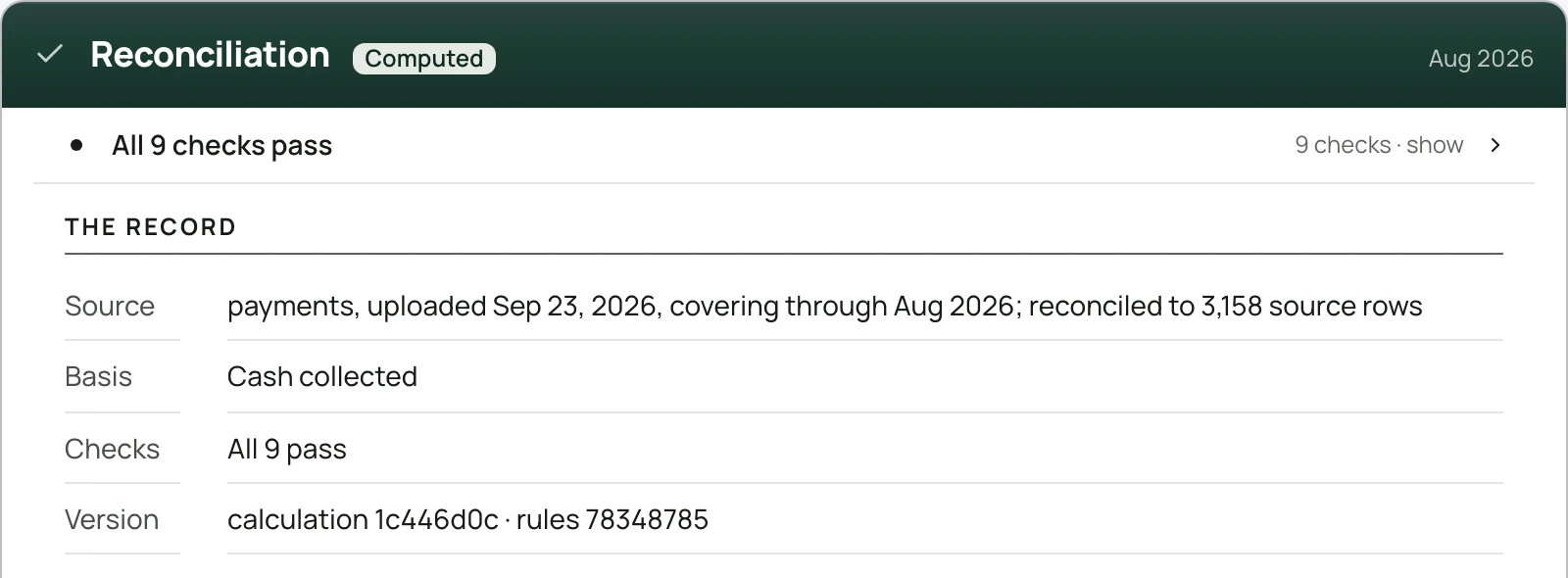
The checks
Ending balance ties | The ending balance reached by adding every movement to the starting balance matches the month's total as read from the rows, for example $41,467 computed vs $41,467 reported. |
Amounts | Each component of the movement adds up to the totals, component by component. |
Customer counts | The ending customer count matches the customers with revenue in the rows. |
Source coverage | Every row was used, set aside or found unusable, and none is unaccounted for. |
Classification completeness | Every row landed in exactly one movement. |
Provenance | The file, the settings and the run are recorded. |
Customer-level comparison | Each customer compared with the previous month. Reads unavailable when only totals were available. |
The analyst may add further rows with notes on something it noticed. Those rows can add a note but can never fail a month.
What the results mean
Each check reads reconciled, differs by basis, partial, needs review, or not evaluated at this level. The line above them summarizes:
All 7 checks pass
2 of 7 checks with notes, naming the checks
1 of 7 checks did not pass
A check that could not be measured says so. It is never counted as a pass.
What a pass does not prove
The ending-balance check confirms that the movement and the rows agree. A month built from the wrong set of rows will still tie. That is why the other checks exist, and why each is shown separately.
A reconciled month means the numbers add up and trace to their source. It does not tell you why they moved.
When a month does not tie
The waterfall is marked Does not tie, and the headline states the gap, for example Off by $312. Morevy does not stretch a bar or round the difference away.
Caution. Do not act on a month that does not tie. Open the checks and the reconciliation on the month view to find where the difference comes from.
The month view's reconciliation
The month view has its own reconciliation, which shows how the month's total follows from everything read: the rows set aside, the rows left out by your answers, and the other months. See The month view.