The Complete Guide to Recurring Revenue Analysis
A repeatable monthly method for turning recurring-revenue data into a number Finance can explain.
Published
·
Updated

Recurring revenue analysis explains how recurring revenue moved in a period and which customers moved it. Done monthly, it has six steps: define the basis, calculate the recurring value, build the movement bridge, reconcile it, trace the customers and source records behind it, and state what the data can and cannot prove.
A revenue total shows where the business ended the month. It does not show what happened along the way, which customers changed, or whether the growth is as durable as it looks.
Before calculating anything, establish the basis. What are we measuring: cash collected, normalized recurring revenue, monthly recurring revenue (MRR), or annual recurring revenue (ARR)? What counts as recurring for this business? Which period are we analyzing, and which source supports the result? A technically correct calculation can still mislead when its basis is unclear.
This guide walks those steps in order. It applies whether customers pay monthly, quarterly, or annually.
Start with the question behind the number
See how recurring revenue moved from opening balance to ending balance.
See how recurring revenue moved →
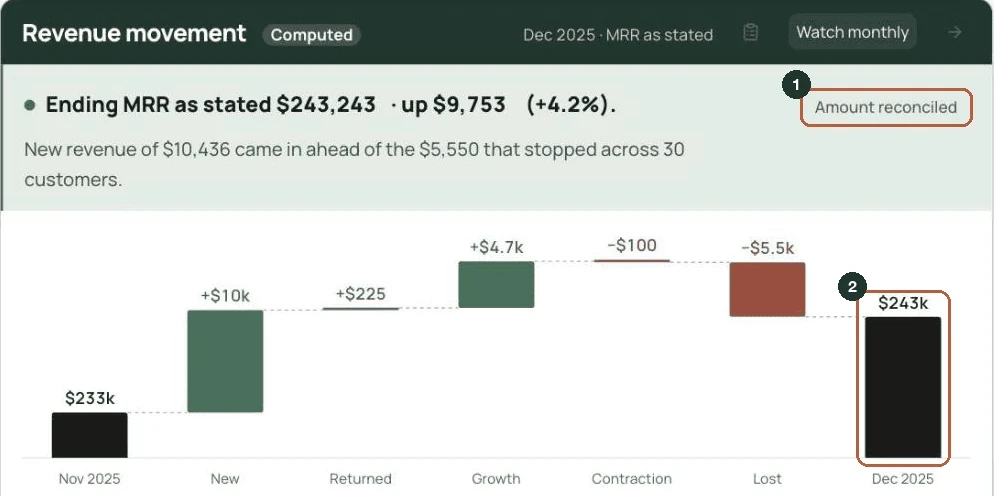
Morevy’s revenue movement for one month. 1: the headline says whether the amounts reconciled. 2: the ending balance the legs walk to.
What Is Recurring Revenue Analysis?
Recurring revenue analysis turns customer-level recurring activity into a reviewable view of what changed, who drove the change, and what the evidence supports. The goal is not to produce another growth number. It is to create a monthly explanation that a finance owner can defend.
That is broader than calculating an MRR or ARR figure. A calculation produces a value. Analysis connects that value to movement, customers, source records, stated rules, exceptions, and the limits of the available evidence.
A four-level analytical hierarchy
Total → Movement → Customer → Source
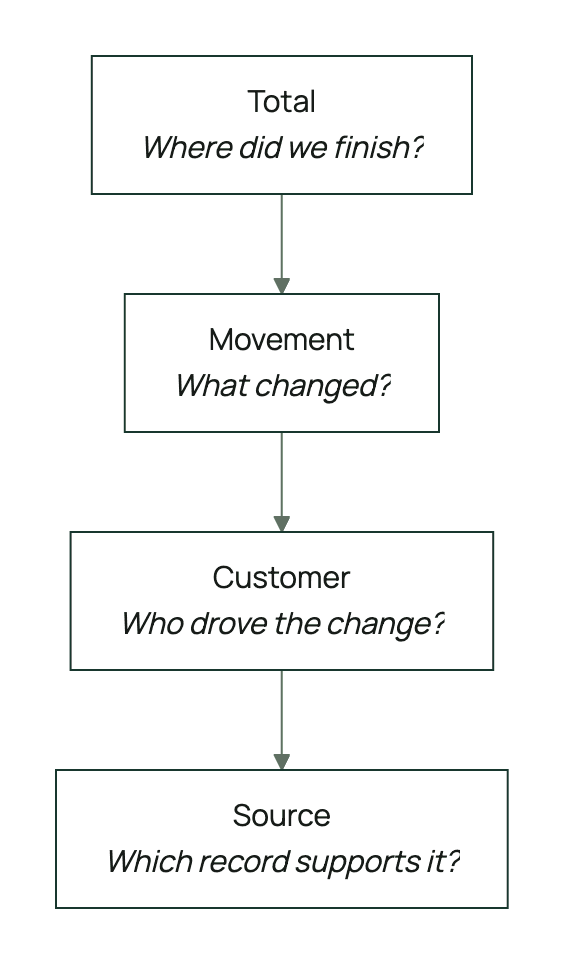
The total answers, “Where did we finish?” Movement answers, “What changed?” The customer view answers, “Who drove the change?” The source view answers, “Which record supports it?” Together, these levels show whether growth came from new customers or expansion, and how much was lost to contraction and churn.
Morevy’s drill-down follows the same hierarchy: open a total to see its movements, open a movement to see the customers behind it. Every figure carries the rows and answers it was computed from.
This structure lets a finance operator review a month without losing the connection between the reported number and the billing activity underneath it. It also keeps recurring value distinct from cash flow and recognized revenue, which answer different questions.
The operating sequence
The hierarchy describes the levels of the review. The sequence describes the order of the work each month:
Define → Calculate → Movement → Reconcile → Investigate → Explain
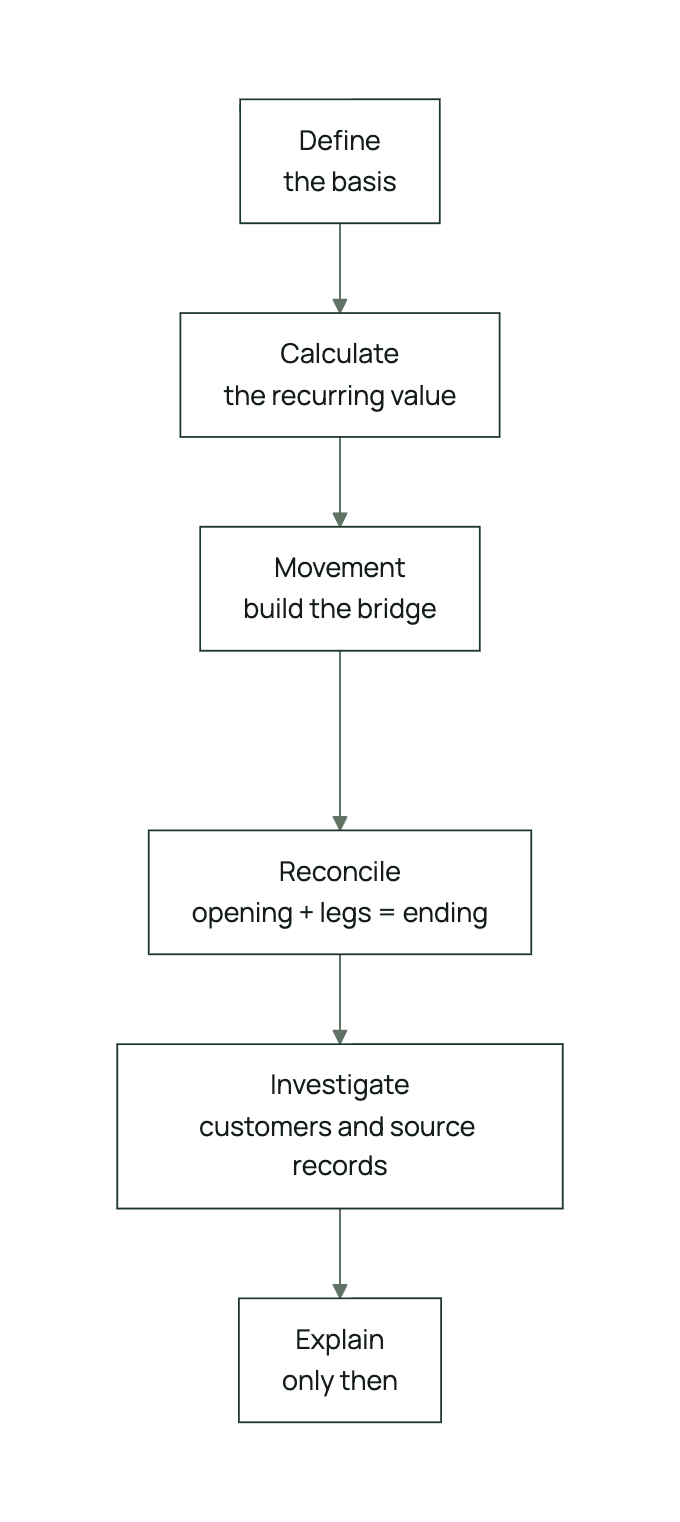
Define the basis, calculate the recurring value, build the movement bridge, reconcile it to the ending figure, investigate the customers and source records behind each movement, and only then explain the result. The rest of this guide follows that order.
Why the ending total is not enough
A business can finish a month with flat recurring revenue while several customers expand and others churn. A growing total may also conceal weak retention if new customers are replacing losses from existing accounts. The number is useful, but the movement explains the health of the business.
Good analysis defines recurring scope, keeps recurring revenue distinct from cash flow and recognized revenue, and records the basis before interpreting growth.
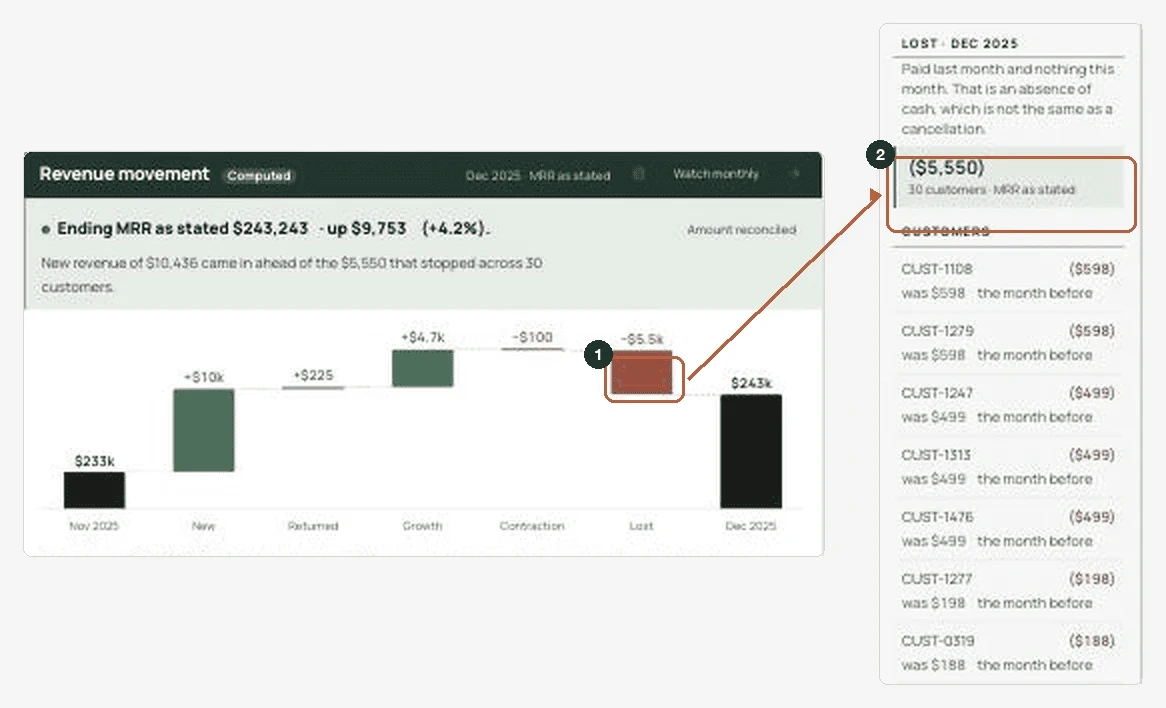
From a movement to its customers. 1: the Lost leg, $5.5k. 2: the same $5,550 as thirty named customers, each with what they paid the month before.
Establish the Basis: MRR, ARR, Revenue, and Cash Answer Different Questions
A recurring-revenue business is usually described by several financial views. They can describe the same business, but they are not interchangeable. Before comparing a number with last month or using it to explain growth, state the basis: what is being measured, what period is covered, which charges count as recurring, and which source supports the result.
Metric | Question |
|---|---|
Cash | What money arrived? |
Revenue | What amount was earned or reported for the period? |
MRR | What is the normalized monthly recurring run rate? |
ARR | What is the annual value of the recurring commitments in force? |
Cash collected
Cash records when customers pay. It supports cash flow planning and collection review, but payment timing does not describe the recurring value of a customer relationship. A customer who pays $1,200 for a year creates $1,200 of cash in one month even though the normalized recurring value is $100 per month.
Recognized revenue
Revenue describes the amount treated as earned or reported under the business’s selected reporting basis. It is not automatically the same as a payment date, a cash flow result, or a subscription run rate. Keep this view separate from operational recurring revenue unless the definitions and period rules are explicitly aligned.
Monthly recurring revenue
MRR normalizes active recurring commitments to a monthly value. A $1,200 annual subscription contributes $100 to each of twelve months when the plan covers twelve months and the company’s stated policy supports that treatment. This is a run-rate measure, not a record of when customers pay.
Annual recurring revenue
ARR is commonly calculated as MRR multiplied by twelve. Strictly, that product is a projected annual run rate. ARR counts the renewable commitments in force at their annual value, and the two match only when all of MRR comes from such commitments. ARR is an annualized view of recurring value, not a promise of annual cash collection or reported revenue. It should always be tied to a defined recurring scope and comparison period.
The same distinction holds whether customers pay monthly, quarterly, or annually. A promotion-heavy month can show strong cash and ordinary recurring revenue. Neither view is wrong. The error is using one basis while labeling it as another. A technically correct formula can still produce a misleading business conclusion when its basis is unclear.
Keep cash and recurring revenue separate
Read how Morevy handles prepaid plans, billing terms, and uncertain periods.
Review cash vs recurring revenue
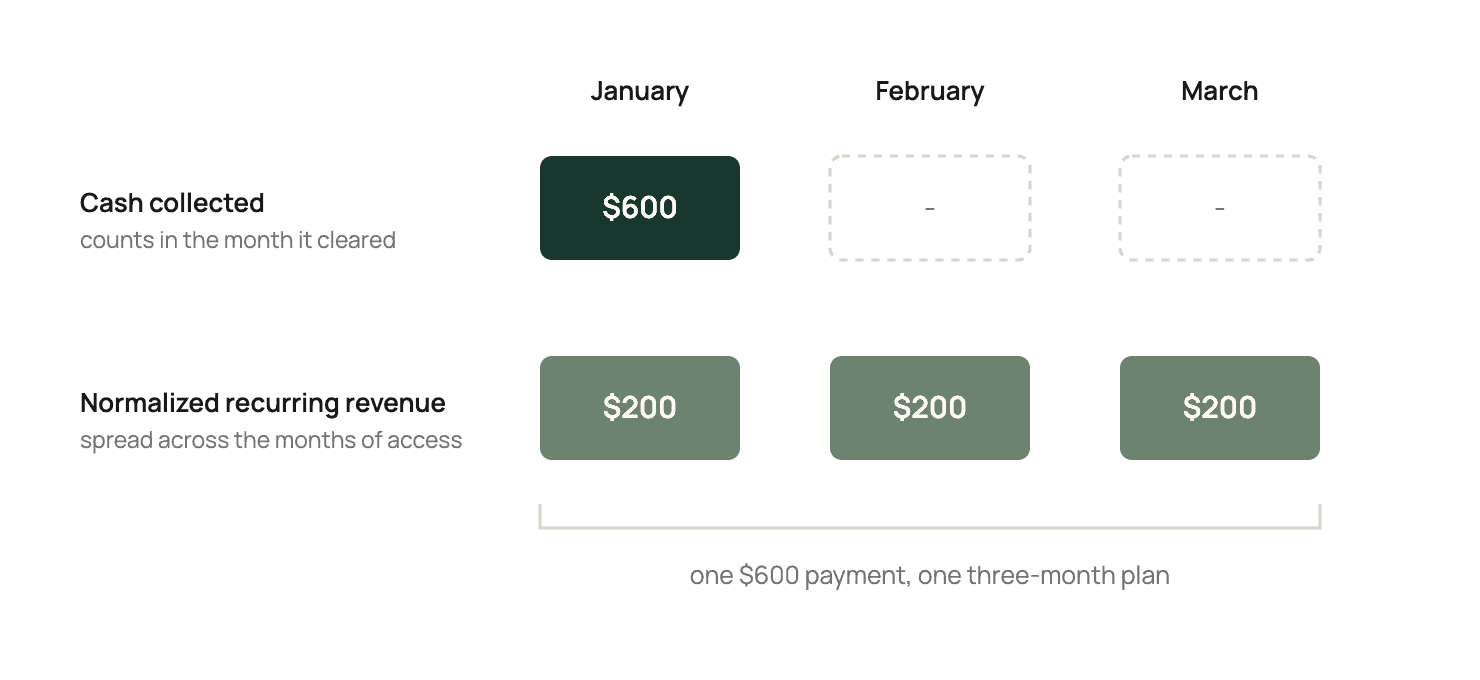
One $600 payment for a three-month plan: cash collected counts it in January; normalized recurring revenue spreads it across the months of access.
How to Calculate MRR Correctly
Start with the recurring scope, not the formula. Include active subscription charges that represent ongoing access or another clearly defined recurring commitment. Exclude one-time services, setup fees, manual project work, and unrelated charges. If the source cannot support a reliable recurring value, document the limitation instead of creating false precision.
Billing frequency
Monthly billing: Use the recurring monthly amount after applying the stated discount policy.
Quarterly billing: Divide the recurring amount by three and assign the normalized value to each covered month.
Annual billing: Divide the recurring amount by twelve when the plan covers twelve months and the service period is established.
Discounts, one-time charges, and refunds
Use one consistent ruling for recurring discounts. If a discount applies to the active subscription, report the effective recurring value rather than the list price. Keep one-time charges outside MRR. Review refunds in context: a service credit may not represent contraction or churn, while a refund linked to a canceled subscription may affect the recurring relationship.
Trials and usage-based revenue
A free trial with a zero amount is not paying recurring revenue. A paid trial may count if it represents an active recurring relationship under the stated policy. Usage-based charges require similar care. If a charge is not committed, predictable, or normalized under a clear rule, report it separately or qualify the result rather than forcing it into the recurring figure.
Stripe may display an MRR figure that is useful for a current snapshot. Historical analysis still requires scope decisions, period normalization, customer joins, movement classification, reconciliation, and source evidence. The Stripe-specific steps are on the dedicated Stripe page.
The MRR Movement Bridge Is the Center of the Analysis
An MRR total shows the ending position for a month. The movement bridge explains how the business got there, which customers changed, and whether the result supports the reported growth.
The reconciliation identity is: Opening MRR + New + Expansion + Reactivation - Contraction - Churn = Ending MRR. Use the bridge every month. Classification is not enough; the movement categories must reconcile exactly to the ending figure before anyone uses the result to explain growth or retention.
Worked movement example
Opening MRR = $100,000
$8,000 Expansion
$4,000 New
−$7,000 Churn
−$3,000 Contraction
Ending MRR = $102,000
Topline growth: +2%.
Ending MRR increased by only $2,000, but $22,000 moved underneath that result. The company added $4,000 from new customers and $8,000 from expansion, while losing $7,000 through churn and $3,000 through contraction. This view shows whether growth came from new customers, from expansion, or from replacing churn.
A total tells you where you landed. Movement tells you what happened.
Why a bridge improves decisions
A bridge gives the finance operator a common monthly structure for reviewing recurring revenue. It shows whether new customers, expansion, reactivation, contraction, and churn explain the change from opening to ending MRR. It also gives the business a starting point for investigating customer concentration, churn, and retention.
Sales can look at new customers, customer teams at expansion and churn, finance at whether every leg adds up, and leadership at whether growth is durable or depends on replacing churn.
Turn a total into a movement story
Explore the deeper commercial workflow for classifying and reviewing MRR movements.
How to Reconcile Recurring Revenue
Reconciliation turns a recurring revenue metric into a reviewable number. It confirms the basis, shows what was included and excluded, tests how each movement was classified, and proves that the bridge ties from opening to ending MRR. Establish that opening plus movements equals ending before descending into the customers behind each category.
Recurring revenue reconciliation checklist
Movement identity: opening MRR plus New, Expansion, and Reactivation, minus Contraction and Churn, equals ending MRR.
Customer-count tie-out: opening paying customers plus new customers minus churned customers equals the ending count, with reactivation handled under the stated ruling.
Spot-check unusual customers: review the largest movement, an annual prepayment, a refund, and a reactivated customer.
Source support: connect material or unusual movements to the available invoice, subscription, or payment record.
Exception log: record missing terms, uncertain classifications, duplicate customers, mixed currencies, and unsupported charges.
Rulings ledger: document choices for discounts, refunds, partial periods, usage, prepaid plans, and the selected basis.
If the dollar bridge ties but customer counts do not, investigate duplicate customer identities, merged accounts, or the treatment of reactivation. If the counts tie but the bridge does not, look for a missed movement, an excluded item, or a double-counted adjustment. A classification is not complete until the result reconciles.
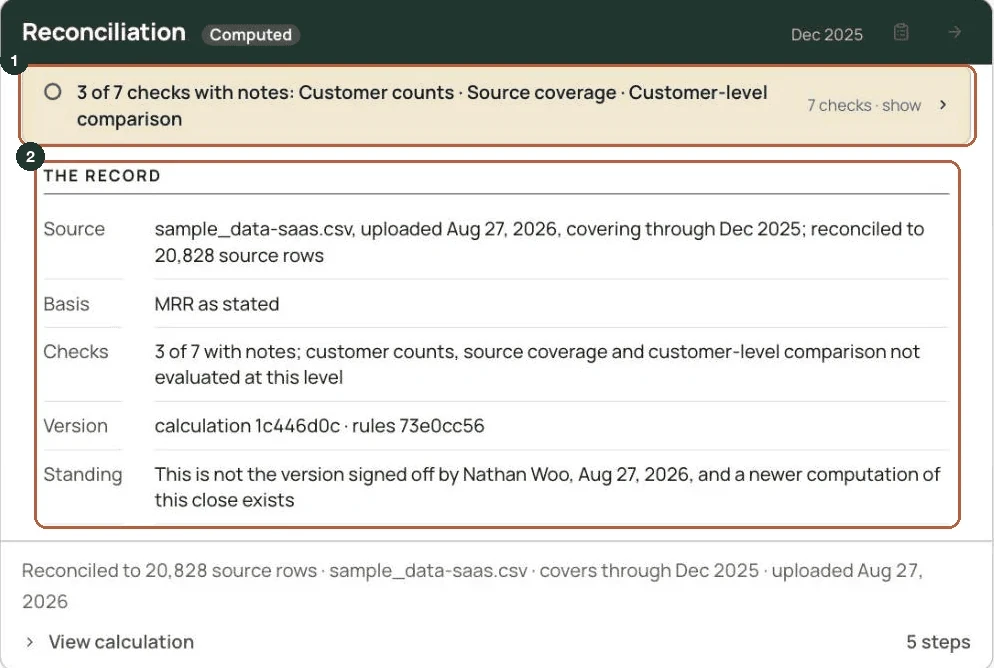
Morevy’s reconciliation block. 1: seven checks graded separately, never a bare “reconciled”. 2: the record beneath them naming source, basis, checks, version and standing.
When a number should be withheld
Sometimes the correct answer is no number. A report can reconcile arithmetically and still misstate the business when its basis or assumptions are hidden. If a material service term cannot be established, spreading its value across a month creates false precision.
Available evidence → Missing evidence → Unsupported calculation → Correct treatment
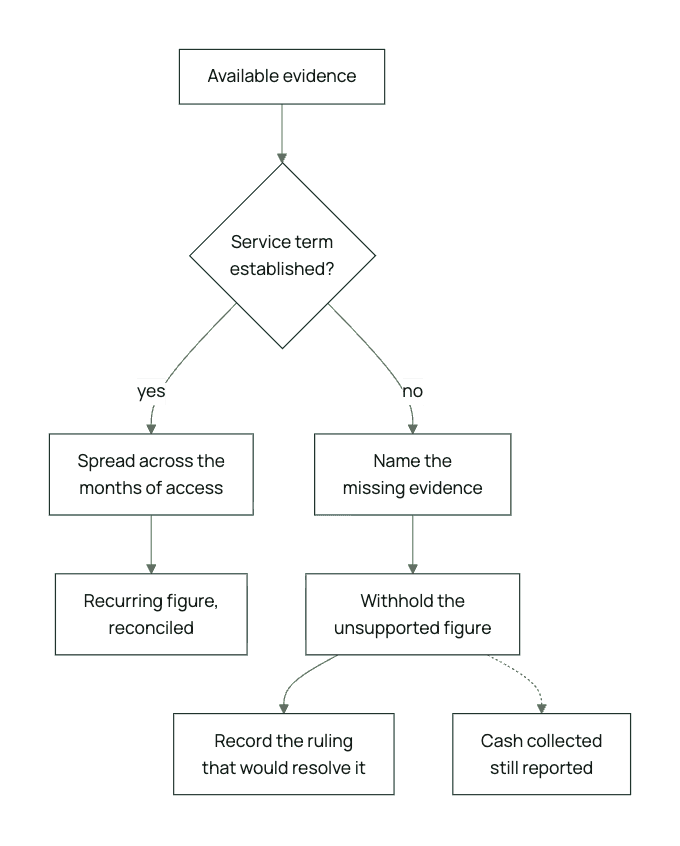
Use the evidence available to identify what can be calculated. Name the missing evidence, withhold the unsupported recurring revenue figure or retention rate, and record the ruling required to resolve it. This is how Morevy behaves: when plan terms cannot be established for a material share of revenue, it declines to run a recurring-revenue close, reports cash collected instead, and says why.
Customer-Level Recurring Revenue Analysis
After the movement bridge ties, descend to the customers behind each category. This is the next level of the analysis, not a substitute for reconciliation.
Leg and customers | Amount |
|---|---|
Expansion | +$8,000 |
Acme | +$4,000 |
Globex | +$2,500 |
Stark | +$1,500 |
This view changes the review from “expansion was strong” to “three customers drove expansion”. It lets an operator compare account concentration and contract size without losing the connection to the monthly total.
Billing evidence and commercial context
Why did Acme expand?
Billing data doesn’t necessarily know.
Billing records can show that Acme’s recurring amount increased from $4,000 to $8,000. They may not show whether the customer added seats, accepted premium features, changed its plan, or agreed to another commercial arrangement. Those explanations require supporting context beyond the movement arithmetic.
Morevy identifies the customers behind a movement when the available source supports that view. It does not infer why a customer paid more, paid less, or stopped paying when the source record cannot establish the reason. Keep the financial conclusion separate from the commercial hypothesis.
Movement Proves Arithmetic.
It Doesn’t Necessarily Prove Motive.
Evidence supports:
Acme MRR increased from $4,000 to $8,000.
Evidence may not support:
Acme expanded because it added 20 employees.
The first statement describes a measurable change in recurring value. The second claims a motive that may not be present in the billing source.
Financial evidence → calculate
Commercial context → operator judgment
Why this boundary matters
An AI system can produce a smooth explanation that sounds reasonable without being supported. A reliable recurring revenue process calculates from source records, shows the evidence, and marks unresolved questions for review. It uses AI after the math, not as a replacement for the math.
Morevy’s evidence-first approach keeps the figures, customer movements, and unresolved context distinct. Commentary can explain a verified result, but it does not invent a number or silently fill a missing commercial reason.
Use billing data to establish what changed. Use additional commercial evidence and operator review to establish why it changed.
Why MRR Numbers Disagree
Compare the basis before comparing totals
Stripe and a spreadsheet can produce different MRR or ARR results when they apply different rules for discounts, proration, refunds, timing, customer identity, or recurring scope. Compare the definitions, source records, and period rules before comparing the totals.
Separate recurring value from cash flow
MRR can change before cash arrives because the active recurring commitment changed. Cash flow measures payment timing, while recurring revenue measures the defined run rate. An annual payment can therefore create a cash spike without creating the same monthly recurring value.
Review discounts, refunds, and customer identity
Apply one documented ruling for discounts and use the effective recurring amount when that is the selected basis. Do not subtract the same refund through multiple records, and do not treat a service credit as churn without evidence of a recurring change. Duplicate customer IDs can turn one continuing customer into false new activity or false churn.
Document scope limits
Mixed currencies, consumption bundles, marketplaces, and usage-based revenue may require evidence that a billing export does not contain. Do not combine currencies without a stated conversion method and date. Include variable charges only under a clear rule; otherwise report them separately from the recurring figure.
A strong analysis names its limits. Withholding a metric is better than presenting a confident but unsupported result, even when the apparent churn rate or ARR total looks precise.
Do not force every charge into the recurring figure. Scope, evidence, and the ruling are part of the calculation.
MRR Movement Categories
Movement labels describe the arithmetic of recurring revenue, not the commercial motive behind it. Apply them consistently after the basis is defined and the customer-level values reconcile.
New
Definition: Recurring revenue from a customer who was not active in the prior comparison period.
Example: A new customer begins a $2,000 monthly subscription in May.
Common mistake: Calling a duplicate customer record new after an identity change.
Evidence: The first active recurring invoice, subscription record, customer ID, and service period.
Expansion
Definition: An existing customer’s recurring value increases while the customer remains active.
Example: A customer moves from $4,000 to $6,000 of monthly recurring value.
Common mistake: Treating a one-time implementation fee as expansion.
Evidence: The prior and current recurring line items, quantity, effective period, or other supported source record.
Contraction
Definition: An existing customer’s recurring value decreases but remains above zero.
Example: A customer reduces a $3,000 plan to $2,200.
Common mistake: Treating a temporary credit or failed payment as contraction without evidence of a recurring change.
Evidence: The prior and current recurring values and the effective subscription period or related source record.
Churn
Definition: Recurring value from an active customer falls to zero under the stated policy.
Example: A canceled $1,500 monthly subscription is no longer active in June.
Common mistake: Calling a failed payment churn while the subscription remains active.
Evidence: Cancellation status, end date, final recurring period, and related invoice records.
Reactivation
Definition: Recurring revenue from a former customer who returns after a period with no active recurring value.
Example: A customer churns in January and starts a new $900 plan in April.
Common mistake: Counting the returning customer as new when the business maintains a separate reactivation view.
Evidence: Prior customer identity, inactive interval, and new active recurring record.
Retention: GRR and NRR
Gross revenue retention
GRR measures how much opening recurring revenue remains after contraction and churn, before expansion and new customers:
GRR = (Opening MRR - Contraction - Churn) / Opening MRR
Net revenue retention
NRR includes expansion and reactivation as well as contraction and churn:
NRR = (Opening MRR + Expansion + Reactivation - Contraction - Churn) / Opening MRR
NRR above 100% means the starting customer group increased in value after its movements. New customers are not included. The same logic applies when a business reports ARR, provided the opening basis and period remain consistent.
When not to calculate them
GRR and NRR require a defensible recurring revenue basis. Collections alone cannot support these definitions, because cash timing mixes annual prepayments, failed payments, refunds, and service periods. A customer who prepaid six months reads as a total loss in each month that follows. If the selected basis cannot support the metric, the correct treatment is to withhold it and document the missing evidence rather than present a precise but unsupported retention rate.
That is a methodology rule, not a product feature: report only what the source and the stated rules can support.
How to Analyze MRR From Stripe
Stripe can provide useful source data for MRR analysis, but an export is not automatically a complete recurring revenue record. Start by defining the basis, period, and recurring scope before using Stripe to calculate MRR or ARR.
Stripe analysis should follow a clear sequence:
Stripe → billing/payment activity → recurring scope → monthly normalization → customer-month → movement → reconciliation
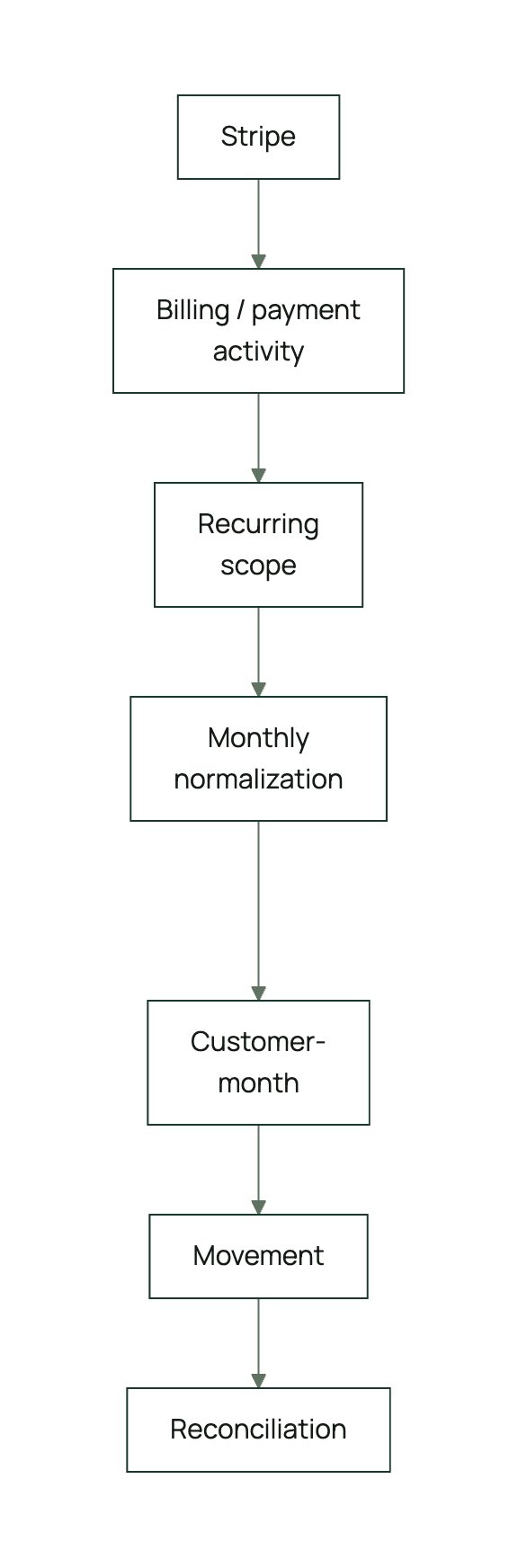
Use invoice line items when service periods and historical normalization are required. Use payments for cash flow questions. Treat subscriptions as useful current-state data, not as a complete historical record for every customer or month.
Filter out one-time items, test data, duplicate rows, and unsupported proration treatment. Before comparing months, record the rules for discounts, refunds, partial periods, currencies, and annual or monthly terms. If the source cannot establish a reliable recurring value, qualify the result or withhold the unsupported figure.
The Stripe page covers export details and worked examples. This page keeps Stripe in its proper role: a source that still requires a stated basis, customer-level review, movement classification, and reconciliation.
Go deeper into Stripe data
Choose the source-specific workflow or the practical calculation guide.
→ Exporting your data from Stripe → How to Calculate MRR from Stripe
What a Monthly Recurring-Revenue Review Should Contain
A monthly recurring-revenue review should preserve more than the final number. It should leave a record that another finance operator can inspect, reproduce, and use to explain the business next month.
Source: Which export, connection, or system supplied the data.
Basis: Cash collected, normalized recurring revenue, or another stated basis.
Rules/Rulings: How the company treated discounts, refunds, usage, prepayments, partial periods, and other scope questions.
Opening: The starting MRR or ARR for the period.
Movements: New, expansion, reactivation, contraction, and churn.
Ending: The closing recurring value after reconciliation.
Customers: The customer records behind material changes.
Exceptions: Missing terms, duplicates, mixed currencies, and unusual charges.
Checks: Movement identity, customer count, source support, and spot checks.
Commentary: An explanation written after the figures are verified.
Record: The inputs, methodology, decisions, withheld figures, and final result retained for the next month.
The reproducibility chain is:
Source → Basis → Rules/Rulings → Checks → Result → Record
The complete recurring-revenue close follows:
Source → Basis → Opening → Movements → Ending → Customers → Exceptions → Rulings → Checks → Commentary → Record
That is what we mean by a recurring-revenue close: the monthly operating process that brings the hierarchy, the sequence, and the record together into something repeatable and reviewable. It is not a formal accounting standard. Its purpose is to make the recurring value, customer movements, evidence, judgments, and limitations clear enough to review and repeat.
Make the monthly review repeatable
See how a recurring-revenue close preserves source evidence, rulings, checks, and commentary.
→ Complete recurring-revenue close workflow
Spreadsheet vs Dashboard vs Complete Review Workflow
Spreadsheets and dashboards can both support a recurring revenue process. The comparison below is conceptual: products and workflows vary in what they support. The important distinction is whether the review preserves only a number or the evidence and decisions needed to explain it.
Spreadsheet | MRR Dashboard | Complete Review Workflow | |
|---|---|---|---|
MRR total | ✓ | ✓ | ✓ |
Historical series | ✓ | ✓ | ✓ |
Movement bridge | Manual | Sometimes | ✓ |
Customer drivers | Manual | Often | ✓ |
Source evidence | Manual | Varies | ✓ |
Explicit rulings | Manual | Varies | ✓ |
Exceptions | Manual | Varies | ✓ |
Commentary | Manual | Varies | ✓ |
Reconciliation | Manual | Varies | ✓ |
Why isn’t my current MRR dashboard enough?
A dashboard may answer “what is the current run rate?” well. A complete review workflow also asks what changed, which customers drove the change, which records support it, what exceptions remain, and which ruling was applied. That context is what lets a finance operator evaluate growth and retention rather than report them.
A spreadsheet can calculate MRR or ARR, and a dashboard can display those figures. The process becomes more useful when it connects the total to the movement bridge, customer evidence, and source record. The method should work the same way regardless of the tool.
Where AI Belongs in Recurring Revenue Analysis
AI should explain verified results, not act as an unsupported calculator for MRR or ARR. It can help an operator explore the data after the basis, rules, and arithmetic have been checked.
Source data → Rules / rulings → Calculation by fixed rules → Reconciliation → Verified result → AI explanation → Human judgment
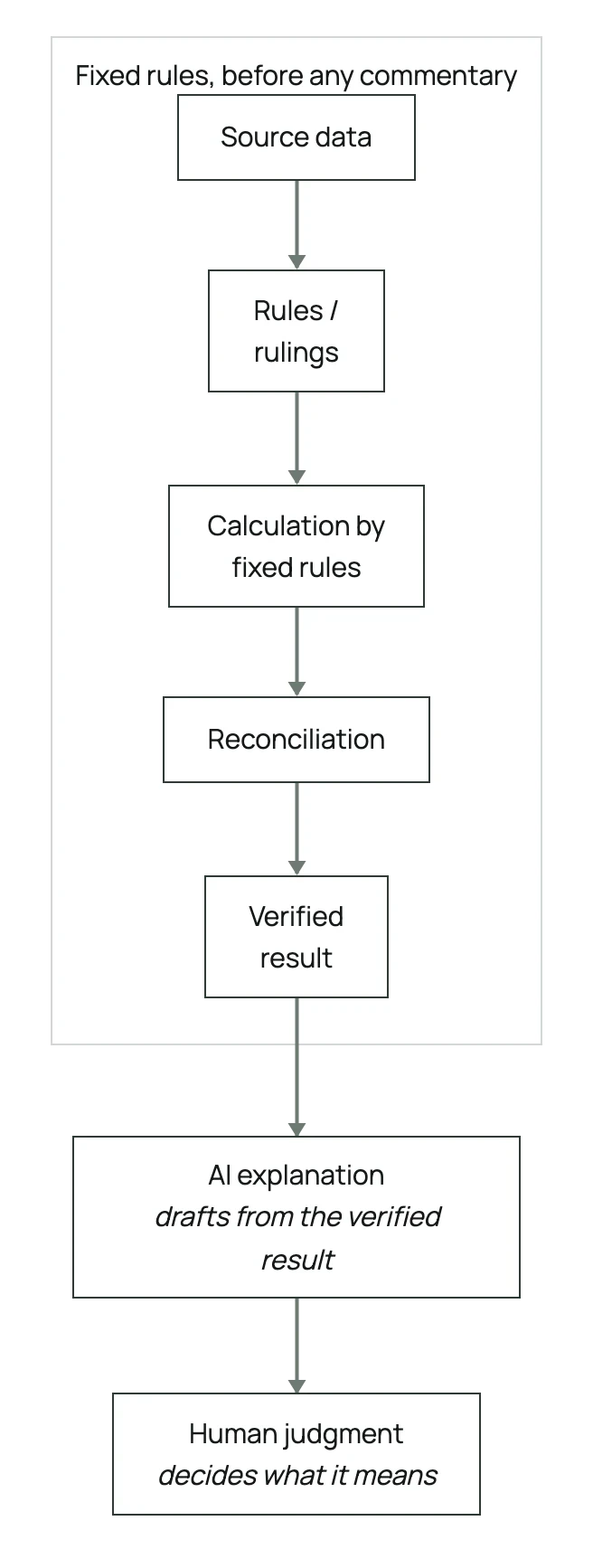
This order matters. Source data defines the evidence, rules define scope, and calculations under fixed rules create the figures. Reconciliation tests the bridge. AI can then draft commentary without becoming the author of the number.
AI MRR analysis with boundaries
Useful AI analysis can identify which customers drove expansion, which movements were largest, and where exceptions need review. It should show the supporting rows and assumptions rather than hide them.
It should not invent a reason for churn, expansion, or contraction. The billing evidence establishes that an existing customer’s value changed; the commercial reason lives outside the billing export.
Morevy as an insight layer
Morevy is built around this method: calculate before commentary, keep the evidence visible, and stop when the source cannot support a reliable conclusion. Human judgment remains necessary when the source cannot establish the reason behind a customer change.
Worked Example: A Monthly Recurring-Revenue Review
Consider a fictional subscription business with an opening ARR of $1.20M. The review covers one month and uses normalized recurring value rather than cash collected.
Basis: Include active recurring subscriptions and normalize confirmed billing terms. Exclude one-time charges. Use billing records for the amounts and customer identities, and mark any unsupported service term as an exception.
Line | Amount |
|---|---|
Opening ARR | $1.20M |
New | +$48K |
Expansion | +$72K |
Reactivation | +$12K |
Contraction | -$24K |
Churn | -$60K |
Ending ARR | $1.248M |
Reconciliation: $1.20M + $48K + $72K + $12K - $24K - $60K = $1.248M
Raw activity and movement classification
The source activity is classified into new, expansion, reactivation, contraction, and churn, so that new customers are separated from changes in the value of existing ones.
Customer drill-down
The $72K expansion is concentrated in three customers. The billing evidence establishes the customer identities and changes in recurring value. Determining whether those changes came from seats, features, pricing, or another commercial event requires additional context.
Churn customers
The $60K churn may include a large account that ended its subscription and several smaller customers that did not renew. Review cancellation dates, final recurring periods, and customer records before describing the churn or calculating a churn rate.
One unusual annual invoice
One customer paid an annual invoice during the month. The cash record shows the full payment, but the analysis spreads the amount across the covered service period when the term is confirmed. This prevents a payment spike from being mistaken for monthly growth.
One ambiguous customer
Another customer has a payment but no reliable service term. Available evidence shows the payment and customer, but the missing term does not support a monthly recurring value. The correct treatment is to mark the exception, identify the source record, and request an operator ruling rather than spread the amount by guesswork.
One withheld metric
If the relevant cohort is supported only by cash data, withhold GRR or NRR. Payment timing cannot support a retention result on that basis.
One operator ruling
The finance owner records that active recurring discounts reduce reported recurring value, one-time charges are excluded, and refunds are not counted twice.
Ending value and resulting commentary
ARR increased from $1.20M to $1.248M, a 4% increase for the period shown. The bridge includes $48K of new ARR, $72K of expansion, and $12K of reactivation, partly offset by $24K of contraction and $60K of churn. One annual invoice was normalized across its confirmed service term. One customer remains under review because the source does not establish the term. Retention metrics are withheld where the cohort is supported only by cash data.
This example shows the method in miniature: define the basis, calculate from the raw activity, build and reconcile the bridge, investigate the customers, record uncertainty, withhold unsupported figures, and write commentary only after the result is checked.
See the workflow behind the example
Review how Morevy turns billing activity into a movement bridge you can explain.
Recurring Revenue Analysis Checklist
Before reporting MRR:
Define the basis: cash collected, normalized recurring revenue, or another stated basis
Define recurring scope and separate one-time revenue
Identify the source and preserve the relevant source record
Normalize monthly, quarterly, and annual billing periods
Establish the opening MRR or ARR balance
Classify new, expansion, reactivation, contraction, and churn movements
Reconcile opening value, movements, and ending value
Reconcile the customer count and review customer identity
Review the largest customer movements and unusual charges
Log exceptions, missing terms, duplicate customers, and currency issues
Document rulings for discounts, refunds, usage, prepayments, and partial periods
Withhold unsupported figures instead of estimating them
Verify source evidence and record the methodology
Draft commentary only after all checks are complete
This checklist turns recurring revenue analysis into a repeatable monthly process, whether customers pay monthly, quarterly, or annually. It preserves the basis, customer detail, exceptions, rulings, and evidence needed to explain growth without overstating certainty.
Conclusion: Build a Revenue Story You Can Defend
Recurring revenue analysis should do more than display a monthly total. It should define the basis, calculate the recurring value, reconcile the movement, investigate the customers and source evidence, and show where human judgment is still required.
Use the hierarchy:
Total → Movement → Customer → Source
Keep cash, recognized revenue, MRR, and ARR in their proper roles. Normalize billing periods, separate one-time revenue, reconcile the bridge, document exceptions and rulings, and withhold any figure the source cannot support. Do not invent commercial motives that billing data cannot prove.
A recurring-revenue close is an operational methodology, not a formal accounting standard. It turns the process into a repeatable monthly record that a finance owner can review, reproduce, and use to explain growth and retention.
Morevy is built around this method: calculate before commentary, keep the evidence visible, and stop when the source cannot support a reliable conclusion.
Your MRR has a story. Ask it.
To turn the bridge into drivers a board can read, see MRR bridges to narrative drivers.
Related reading: What Is an ARR Bridge and Why SaaS CFOs Need One, Key questions to ask about recurring revenue analytics platforms and How to Automate SaaS Revenue Categorization Logic.
Join Morevy’s early access for an evidence-first way to review recurring revenue, customer movements, and the context behind each month.
Frequently asked questions
What is recurring revenue analysis?
+
It is the process of defining a recurring basis, reconciling recurring revenue, classifying movements, identifying customer drivers, and connecting results to source evidence.
How do you reconcile MRR?
+
Check that opening MRR plus New, Expansion, and Reactivation, minus Contraction and Churn, equals ending MRR. Then tie out customer counts and unusual source records.
Why doesn't Stripe MRR match my spreadsheet?
+
The systems may use different rules for discounts, refunds, prorations, billing periods, customer identity, source data, or recurring scope.
What is NRR?
+
NRR measures the value retained from a starting customer group after expansion, reactivation, contraction, and churn. New customers are excluded.
What is a recurring-revenue close?
+
It is an operational, repeatable monthly process that preserves source, basis, opening value, movements, customers, exceptions, rulings, checks, ending value, commentary, and the methodology record.