When Payment Data Can't Support an Honest Retention Ratio
The same three customers give a net revenue retention of 22.5% on cash and 93.3% on recurring revenue. When to withhold the ratio, and how to report it.
Published
·
Updated

Net revenue retention is one of the first ratios a board asks for. It is also one of the easiest to compute from data that cannot support it. Push a payments export through the formula and a number always comes out. Whether that number measures retention is a separate question, and on a lot of real files the answer is no.
This post covers the cases where the honest answer is no ratio at all, and how to report that clearly.
What a retention ratio assumes
Gross and net revenue retention ask one question. Of the recurring revenue you started the month with, how much recurring revenue do those same customers carry at the end? Gross counts only what was kept. Net also counts what those customers grew into.
Two things have to be true for the answer to mean anything. You need each customer's recurring revenue in both months, compared customer by customer. And both months have to be on the same basis, with revenue placed in the months it covers rather than the months it was paid.
The first requirement is well understood. As Randall Lucas of SaaS Capital puts it, "A sophisticated outsider like an investor or buyer will demand a per-customer re-calculation anyhow." The second is the one a payments export quietly breaks.
The same three customers, two answers
Take three customers. The figures are illustrative, not from a real company.
Customer A pays $1,000 every month.
Customer B prepays $6,000 in January for six months of service.
Customer C pays $1,000 in January, then downgrades to $800 in February.
Measure February's month-over-month net revenue retention on each basis.
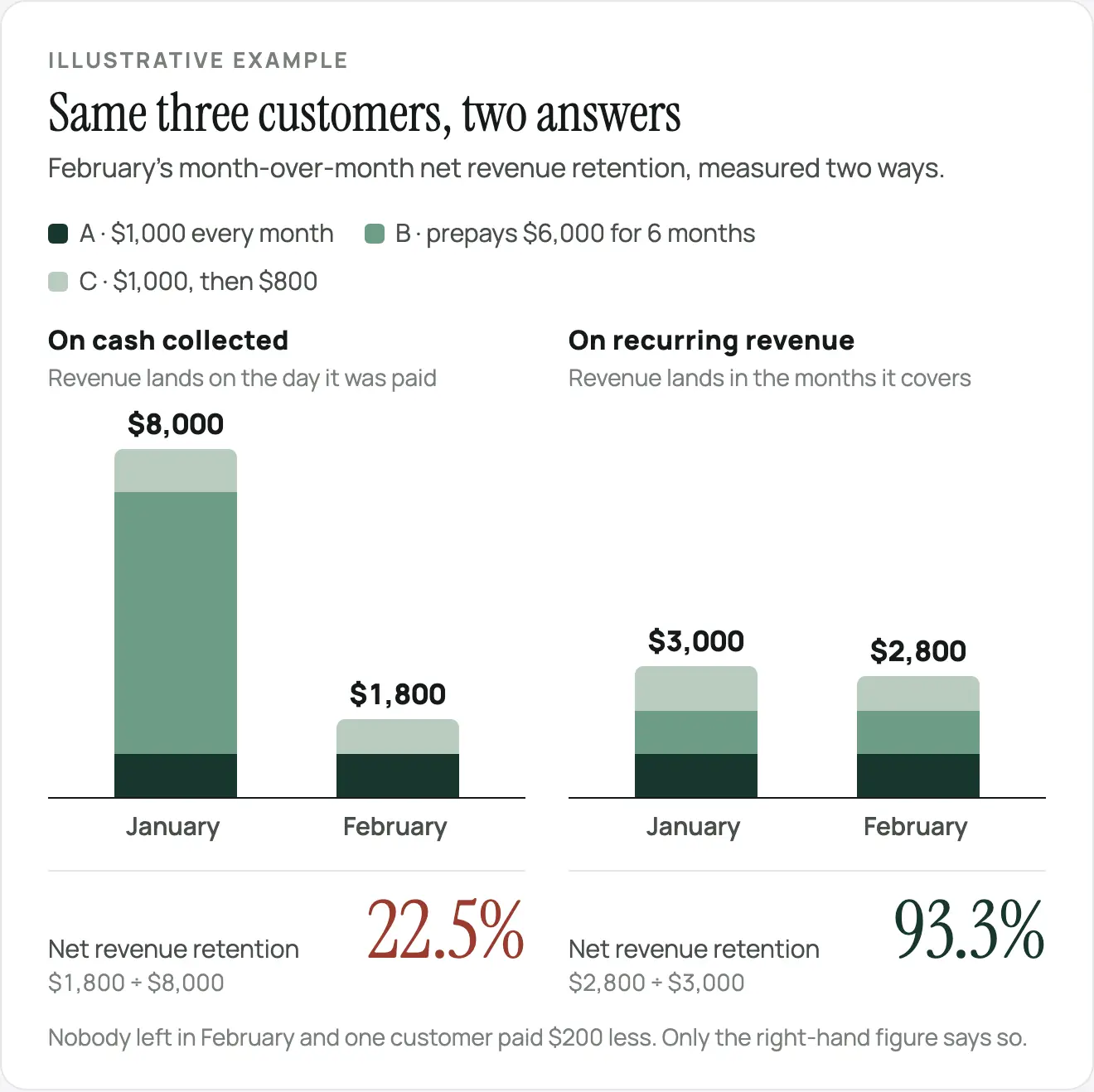
On cash collected, February's net revenue retention is $1,800 ÷ $8,000, or 22.5%. On recurring revenue, it is $2,800 ÷ $3,000, or 93.3%.
Only one of those describes the business. Nobody left in February. One customer paid less. The cash figure reports that Customer B churned, when all B did was pay in advance. Six months later, when B renews with another $6,000, the cash total jumps by $6,000 from a customer whose spend never changed.
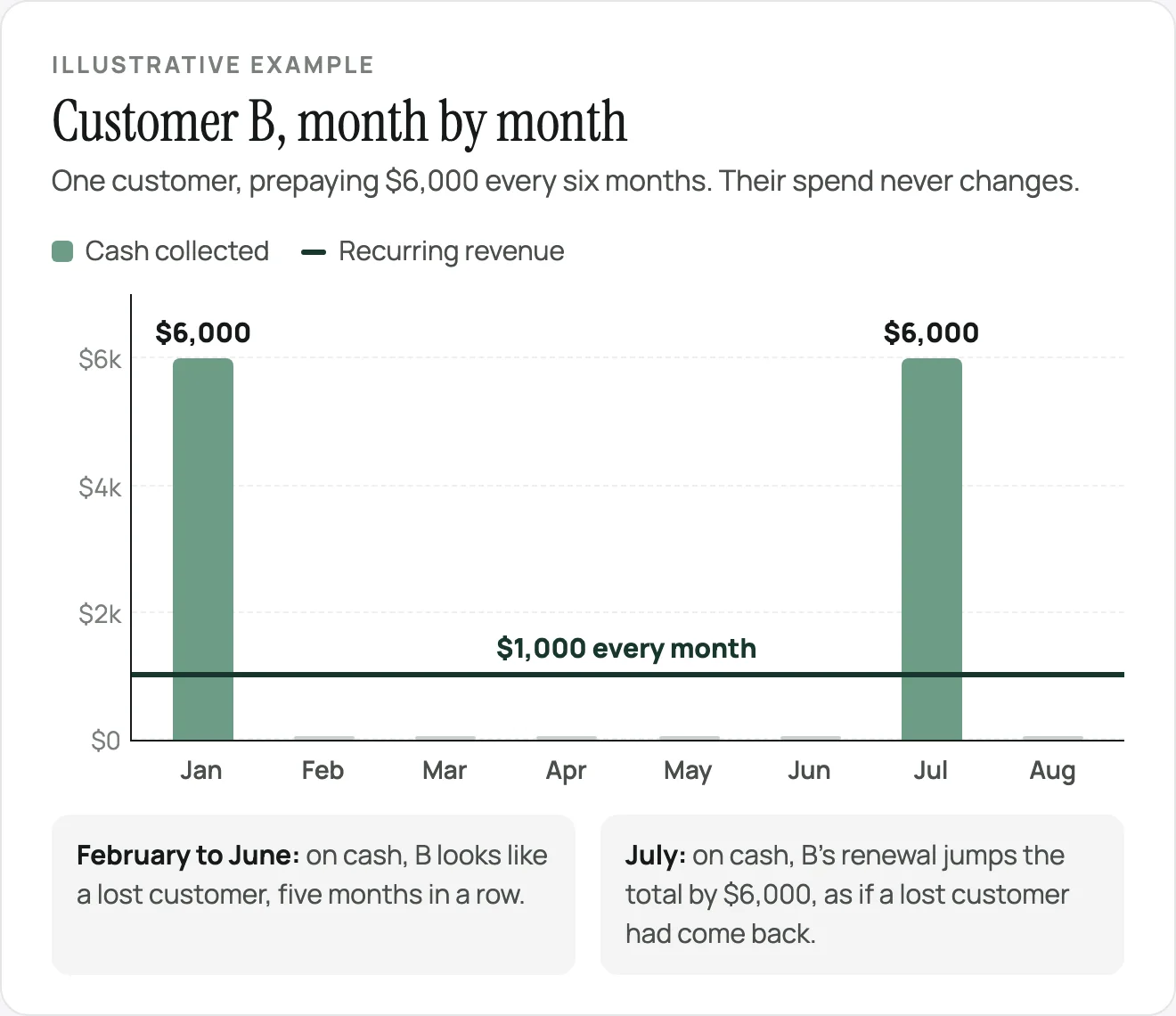
The formula did nothing wrong. It was handed payment timing and asked to measure customers.
Five ways a payments export breaks the ratio
1. Cash standing in for recurring revenue. This is the example above. A payments export records money on the day it moved, not the months it paid for. Any retention ratio built on it treats every prepay as a loss followed by a recovery. What would fix it: recurring revenue placed in the months it covers.
2. Plan terms the file does not state. To spread a prepay across its months, you need to know how many months it covers. When a large share of revenue sits on plans whose names and fields do not say, a $6,000 payment could be six months, twelve months, or a one-off purchase. Any spreading is a guess, and the ratio inherits it. What would fix it: plan lengths on the file, or plan names that state the term.
3. Too few customers. With a handful of accounts, one upgrade or one cancellation can move the ratio a long way. The ratio then describes one account, not the business. What would fix it: enough customers in the comparison that no single account decides the result.
4. Too little history. If the export starts inside the period you are measuring, customers who prepaid before the window are missing from the starting base, and customers returning after a gap look new. The starting base is wrong before any retention is computed. What would fix it: at least one full billing cycle of history before the first month you report, a full year if you sell annual plans.
5. One customer under two records. A customer who moves from card billing to invoicing can end up as two customers in the data: one that stopped paying and one that started. One SaaS operator described spending "a couple hours per month adjusting the numbers" because every such switch showed up as churn plus new revenue. The ratio records a loss that never happened. What would fix it: the two records matched to one customer before anything is compared.
Why a softer number is worse than none
The tempting fix is to print the ratio with a footnote, or to adjust it until it looks reasonable. Both fail the same way. The number gets pasted into a deck, compared with last quarter and quoted back months later, and the footnote does not travel with it.
It also fails at the worst moment. An investor or a buyer will recalculate retention customer by customer, from the source data. A ratio that only held up because of how it was presented will not survive that, and once one figure falls apart, every other figure on the page gets questioned with it.
A withheld ratio with a clear reason does the opposite. It shows the figures were tested, and that the ones printed passed.
How to say it instead
A withheld figure needs three things: which figure, why it is withheld, and what would let it print.
For a cash-only export:
Net revenue retention: withheld. This month is on cash collected, so revenue is recorded on the day it was paid, not the months it covers, so a ratio would measure payment timing rather than retention. Plan lengths on the export would let it print.
For a small customer base:
Net revenue retention: withheld. Fewer than ten customers are in the comparison, so one account would decide the result. More customers in the comparison would let it print. Customer-level movement is shown below.
What you can still say honestly
Withholding the ratio does not leave the month empty. On the same data you can still show:
How revenue moved. Starting revenue, then who was new, who paid more, who paid less, who stopped paying, and ending revenue, with the movement adding up to the ending total.
The customers behind each change. Who paid, how much and when, with every figure traced to the rows it came from. A reader can see Customer B's January prepay for what it is.
Cash collected. Labeled as cash, it answers a real and separate question.
Label all of it by its basis. On cash, the movement follows payments, so a prepaid customer shows as stopped paying in the months after they paid. Named as cash, and with the customers listed, nobody reads that as churn. A retention ratio is different: calling it cash does not make it measure retention. That is why it is the one figure withheld.
How Morevy handles it
Morevy leaves new and returning customers out of every retention ratio, so each one describes the book the month started with. It shows gross and net revenue retention when a month is on normalized recurring revenue, or when the file already states recurring revenue per month or per year. On a cash-collected basis, both ratios are withheld and the reason is shown on the month. Any ratio is withheld when fewer than ten customers are involved.
When a figure is withheld, Morevy names it and says what would let it print, such as adding plan lengths to the file. The rules are in Retention and churn, and the two bases are explained in Cash vs recurring revenue.
Frequently asked questions
Why can't net revenue retention be calculated on cash collected?
+
Cash records money on the day it was paid. A customer who prepays six months looks like a large payment followed by five months of nothing, so a cash-based ratio reports them as lost and later as regained. Retention needs revenue placed in the months it covers.
Can I estimate plan terms to get a ratio anyway?
+
Not for a figure that will travel. An estimated term becomes part of the ratio, and the label explaining it rarely goes where the number goes. Withhold the ratio and state that plan lengths would let it print.
How many customers do you need for a meaningful retention ratio?
+
Enough that no single account decides the result. With a handful of customers, one upgrade or cancellation moves the ratio more than anything else could. Morevy withholds any ratio when fewer than ten customers are involved.
What should I show a board instead of net revenue retention?
+
The revenue movement for the month, from starting to ending revenue with the customers behind each change, plus cash collected labeled as cash. Add a one-line note naming the withheld ratio and what would let it print.
+