How to Calculate Annual Recurring Revenue (ARR)
What ARR counts, how to calculate it from your contracts, and how to explain what changed between two dates.
Published
·
Updated
Annual recurring revenue (ARR) is often calculated as current monthly recurring revenue (MRR) multiplied by 12. That figure is a projected annual run rate: this month's recurring revenue carried across a year. ARR is narrower. It is the yearly value of the recurring commitments a business has in force on a given date: the subscriptions and contracts that customers have agreed to pay for and that renew, at their current price.
The two match only when every dollar of MRR comes from a renewable commitment. Month-to-month subscribers, usage charges, and one-off fees push them apart. A customer on a $12,000 one-year subscription adds $12,000 to ARR whether they pay upfront or monthly.
ARR is a snapshot. It does not promise that customers will stay another year, say when cash will arrive, or equal the revenue recognized over the last twelve months. To explain how it changed, you need the customers and movements behind it: new, expansion, reactivation, contraction, and churn.
What ARR counts
This guide defines ARR as the yearly value of active, renewable recurring commitments on a stated date. Each subscription or contract counts at its current recurring price, expressed per year. Anything you cannot tie to a renewable commitment belongs in a different measure, such as run rate, bookings, services, or pipeline.
Write the definition down as a short ARR policy: what counts, what does not, and how the figure is calculated. Burkland recommends keeping it to one page. [3]
ARR and projected annual run rate
The projected annual run rate is MRR × 12. It is a useful operating signal because it moves as soon as monthly revenue moves. It also annualizes customers who have committed to nothing beyond the current month. ChartMogul calls this measure annual run rate. [1]
Month-to-month subscribers need a policy
Some companies leave month-to-month subscribers out of ARR and report them in MRR or run rate. Others include them at twelve times their monthly price and label that portion. Either choice can be defended. Mixing them without saying so cannot. [2]
This matters most when you compare businesses. A fractional CFO with several clients can see ARR reported three ways: one client counts only annual contracts, another annualizes every monthly subscriber, and a third includes usage. The label is the same and the numbers are not comparable. Ask for the policy before you compare them.
How to calculate ARR
ARR = the sum of each active commitment's annual recurring value on the reporting date
Start from the subscription or contract record, not the payments.
List every commitment in force on the reporting date.
Take each commitment's current recurring price per year. For a flat price, divide the recurring contract value by the term in years.
Add them up.
Apply your month-to-month policy to anything without a term.
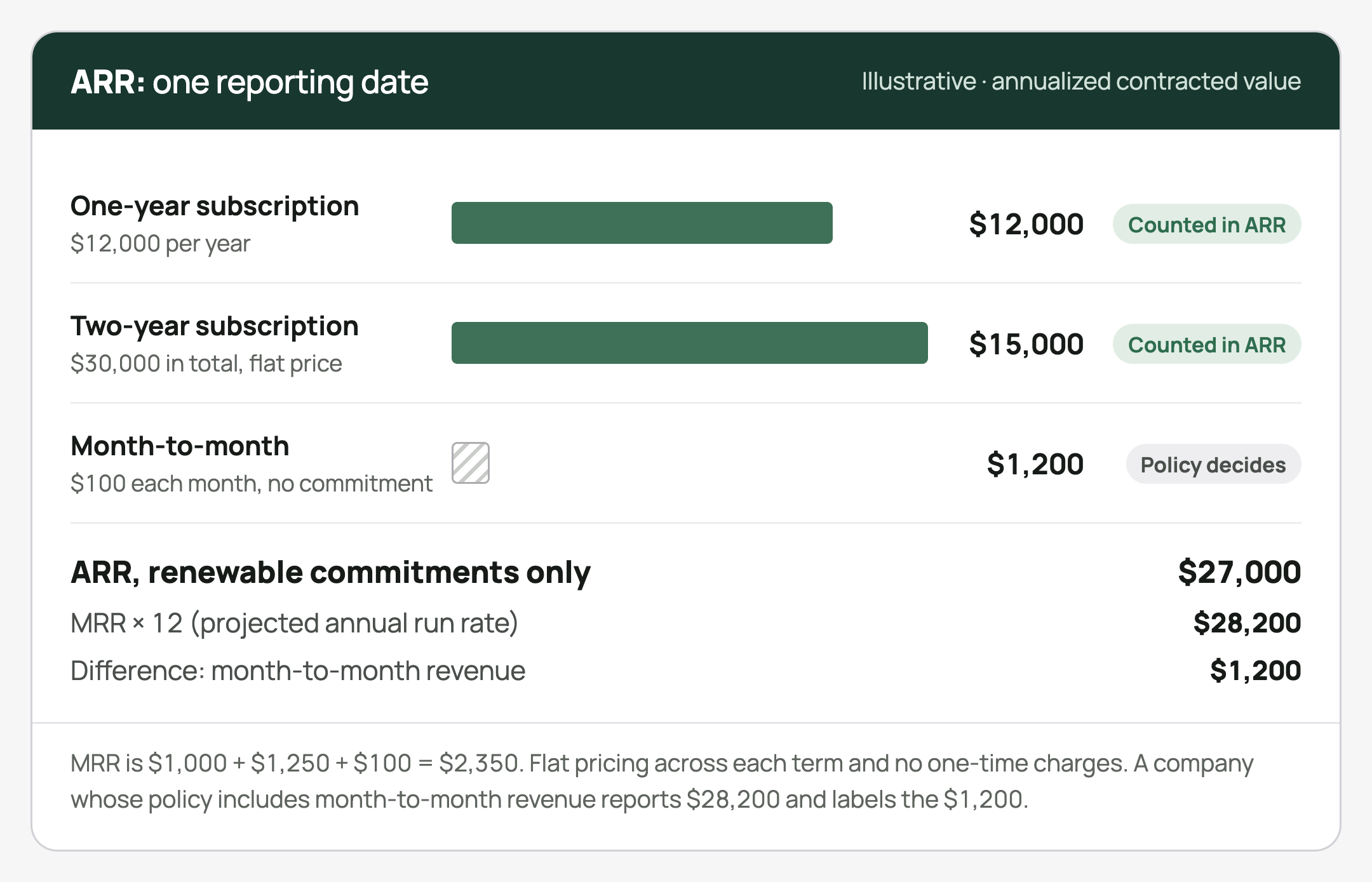
Illustrative commitments on one reporting date.
Active commitment | Annual recurring value | Counted in ARR |
|---|---|---|
One-year subscription, $12,000 per year | $12,000 | Yes |
Two-year subscription, $30,000 in total, flat price | $15,000 | Yes |
Month-to-month, $100 a month, no commitment | $1,200 of run rate | Only under a stated policy |
The examples assume flat pricing across each term and no one-time charges. A payment amount does not tell you the term. Check the contract or subscription record instead of inferring the term from the cash.
What belongs in ARR
Item | Treatment |
|---|---|
Subscription fees under a renewable commitment | Include at the current recurring price. |
Month-to-month subscriptions | Follow your policy: leave out and report in MRR or run rate, or include at twelve times the monthly price and label that portion. |
Recurring add-ons and seats | Include while active. Reflect price or quantity changes from the date they take effect. |
Recurring discounts | State whether ARR uses list price or the discounted price, and apply the same rule every period. |
One-time setup or project fees | Exclude. |
Renewal at the same price | No change to ARR. Do not add the renewed amount again. |
Signed contract that has not started | Keep out of current ARR. Report it separately as contracted but not yet live. |
Variable usage and overages | Keep separate, or include under a stated method. One large invoice is not a recurring commitment. |
Credits and refunds need context. A credit can reverse a billing error, compensate for a service problem, or come with a change to the contract. The cash adjustment alone does not tell you whether ARR expanded, contracted, or churned.
The ARR movement bridge
ARR tells you where the business stands on one date. A movement bridge explains how it got there from the previous date. Calculated from the same data and definitions, the two arrive at the same ending balance.
Ending ARR = Starting ARR + New + Expansion + Reactivation − Contraction − Churn
Measure each movement as a change in yearly recurring value, not as cash received or revenue recognized. A contracted price increase of $200 a month adds $2,400 of expansion ARR on the day it takes effect, even if that day falls midway through the year.
Movement | What happened |
|---|---|
New | A customer takes out their first recurring commitment. |
Expansion | An existing customer's recurring value goes up. |
Reactivation | A former customer returns after a period with no active commitment. |
Contraction | An existing customer's recurring value goes down and they stay active. |
Churn | A customer's recurring value ends, under your stated policy. |
Use customer history to tell reactivation from new business. Decide whether you measure each customer's net change over the period or every event within it, and use the same approach every period. Count each change in one category only. If a currency move or a change of method affects the bridge, show it as its own line rather than folding it into a movement.
Worked ARR examples
These examples are illustrative calculations, not results from named companies.
Month-to-month subscribers
Fifty customers each pay $100 a month with no annual commitment. MRR is $5,000 and the projected annual run rate is $60,000. Under a contract-only policy, these customers add nothing to ARR. Under a policy that includes month-to-month revenue, they add $60,000. That portion is labeled as annualized month-to-month revenue because none of it is committed past the current month.
Annual subscriptions paid monthly
One hundred customers each hold a one-year subscription at $12,000, paid at $1,000 a month. ARR is 100 × $12,000 = $1.2 million. Paying monthly instead of upfront changes when the cash arrives, not the recurring price.
Growth with expansion and churn
A company starts the period with $1 million of ARR. New customers add $250,000, existing customers expand by $120,000, and churn removes $90,000. There is no contraction, reactivation, currency effect, or change of method.
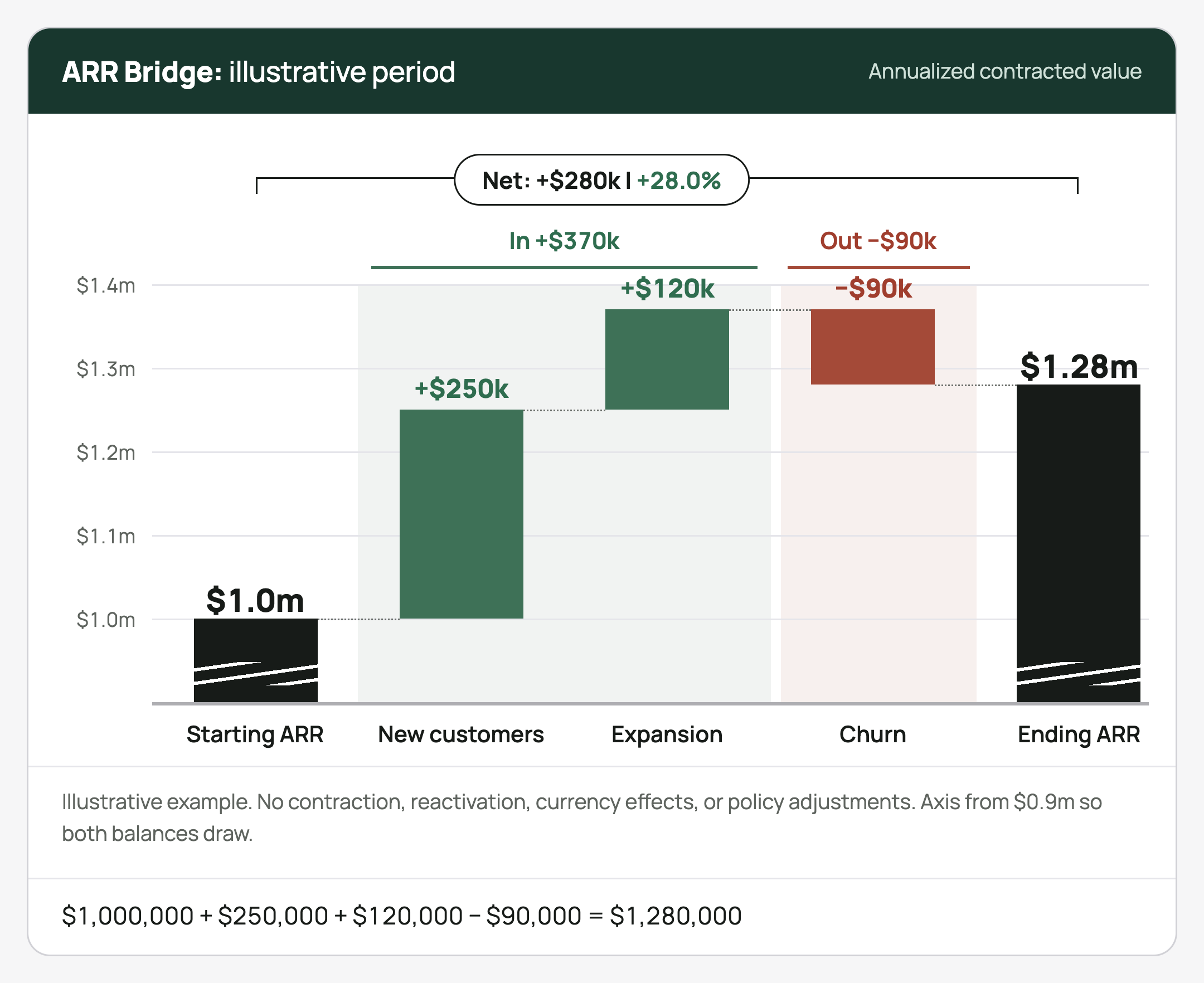
The bridge separates the gains and losses behind a net increase of $280,000.
Component | ARR |
|---|---|
Starting balance | $1,000,000 |
New customers | +$250,000 |
Expansion | +$120,000 |
Churn | −$90,000 |
Ending balance | $1,280,000 |
ARR rose by $280,000, or 28%: $370,000 of gains less $90,000 of losses. Each line points to specific customers and changes to look into.
How to calculate ARR for multi-year contracts
For a flat multi-year contract, divide the recurring value by the term. A four-year subscription worth $50,000, with no one-time fees, counts $12,500 a year.
Price steps need a rule. A three-year subscription priced at $10,000, then $15,000, then $20,000 averages $15,000 a year. Under a current-price policy, it counts $10,000 in year one and steps up when each new price takes effect. The $15,000 average is annual contract value, not current ARR. Report the two separately, along with any committed future value.
Before you record a step-up, check that the contract changes the price. A change in the billing schedule alone is not a price increase.
ARR vs revenue, bookings, and cash
Measure | Question it answers |
|---|---|
MRR | What is the current recurring value for one month? |
Projected annual run rate | What would current MRR amount to over a year (MRR × 12)? |
ARR | What is the yearly value of the recurring commitments in force on this date? |
Bookings | What contract value was signed during the period, under your bookings definition? |
Recognized revenue | What revenue belongs in the accounts for the period, under your accounting policy? |
Cash collected | What payments arrived during the period? |
A multi-year booking can be larger than the ARR it creates, because the booking covers several years. A prepayment raises cash at once and leaves ARR unchanged. [4]
Recognized revenue can be higher or lower than ARR. Revenue covers a period and ARR describes one date, so a business that grew late in the year can end with ARR above the revenue it recognized that year.
When MRR × 12 and ARR differ, the gap is usually month-to-month revenue, usage, or a signed contract that has not started. Tracking both shows how much of the monthly base is committed.
How to check ARR before reporting it
State the reporting date, the customers in scope, and your ARR policy.
Match each charge to a customer and to the contract or subscription behind it.
Separate committed recurring value from one-time charges, future starts, and payment timing.
Apply the same rules to discounts, credits, usage, cancellation dates, and currencies.
Check that the starting balance plus the movements equals an ending balance calculated separately.
Look into material gaps and write down anything that limits the result.
If a term or a recurring amount is missing, say what evidence is missing. A spreadsheet that balances does not make an assumption true. If you can support only part of the base, report that part and label its coverage.
Where Morevy fits
Morevy helps fractional CFOs and finance operators calculate recurring-revenue movements from billing data, see the customers and segments behind each change, and draft commentary for review. It reads Stripe directly or a billing export you upload.
Billing data shows what customers paid, not what they signed. Contract terms and your ARR policy come from you. Morevy records them as rulings and reuses them in later months.
For the wider monthly workflow, read the recurring-revenue analysis guide. To try it on your own data, get started with Morevy and book a time to set up your workspace.
Sources
[1] ChartMogul Help Center. Report Annual Run Rate.
[2] ChartMogul. Annual Recurring Revenue and Annualized Run Rate.
[3] Burkland. AI ARR You Can Defend: A Seed-to-Series A Playbook for Metrics and Diligence.
[4] ChartMogul. Bookings Definition Formula and How It Differs from Revenue.
Frequently asked questions
Is ARR the same as MRR × 12?
+
No. MRR × 12 is a projected annual run rate. It equals ARR only when every dollar of MRR comes from a renewable commitment. Month-to-month subscribers, usage, and one-off charges inside MRR make the two differ.
Does ARR require annual contracts?
+
Under the definition in this guide, ARR counts renewable commitments. Month-to-month subscribers are either left out and reported in MRR or run rate, or included at twelve times their monthly price and labeled. State which, because the choice can change the headline figure.
Does a renewal increase ARR?
+
A renewal at the same price, with no gap, leaves ARR unchanged. Only a change in the recurring value is expansion or contraction. A customer who returns after a period with no commitment may count as reactivation.
Can ARR be used as a revenue forecast?
+
ARR can be a starting point. A forecast also needs assumptions about new sales, cancellations, expansion, start dates, and revenue recognition. A cash forecast needs payment terms and collection timing as well.
How is ARR different from bookings?
+
Bookings measure the contract value signed during a period. ARR measures the yearly value of the recurring commitments in force on a given date. A multi-year booking can be larger than the ARR it creates, because the booking covers several years.